Circular Economy in Indonesia: The Purpose and Way to Contribute

Updated: Jun 13
As human development advances year by year, global society receives both benefits from the advancement and challenges. One of the most urgent discussions among international actors is how to cope with the climate emergency. One concept that emerged as a potential answer to this complex challenge is the Circular Economy (CE).
So, what is CE? Basically, CE is not a new concept in this era. Before being widely recognized, CE was commonly found in the science field as a way to prevent waste, which protects the environment. This concept has been implemented in various areas, including business, education, social service, health, and government. Some well-known global works related to CE are the Sustainable Development Goals (SDGs), which consist of 17 global goals to build a better future for generations, and the Paris Agreement, a legally binding international treaty on climate change.
Generally, CE is the concept to ensure every process made by humans and for humanity has a long lifespan and produces zero waste. Its purpose is to ensure that all benefits received for the sake of humankind are also received by others, including our planet. The core of CE is related to the SDGs’ five focus areas: People, Planet, Prosperity, Peace, and Partnerships (5Ps)[1]. As there is an urgency for a transformation from a linear to a circular economy, this concept is relevant to contribute to the achievement of SDGs, where the benefits would be manifested for any living thing on earth (See Figure 1) [2][3]

Thus, the concept of CE is widely used since many people have become aware of the importance of sustainable living and the environment. Its popularity is increasing gradually as many initiatives, whether at the global or national level, are made in various fields in the way to pursue a better life for everyone around the world. Knowing the trend of CE nowadays, how is the ongoing CE in Indonesia as a country with abundant natural resources and attractive marketplaces for global and national market players?
According to the official Press Release of the Coordinating Ministry for Economic Affairs in 2021, the Indonesian Government is committed to transforming the economy of Indonesia to follow CE [4]. Through this commitment, Indonesia would bring positive environmental impacts – reducing greenhouse emissions by as much as 29% in 2030 – and develop economic development gradually – elevating 41% higher international partnerships. There is a prospect that Indonesia would open 4.4 million jobs and bring CE investment for around USD 21.6 billion.
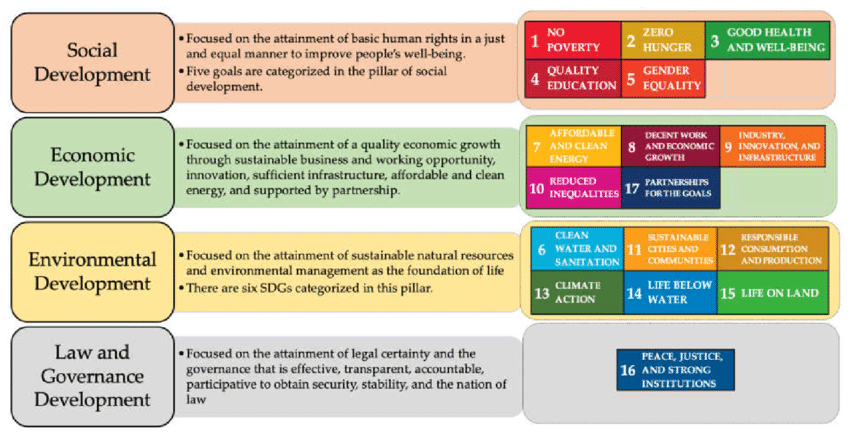
The commitment of the Indonesian Government to support CE is generally stated in the National Medium-Term Development Plan 2022–2024 and explained technically in the Nationally Determined Contribution Indonesia 2030, which focuses on four types of resilience (e.g., Climate Resilience, Economic Resilience, Social and Livelihood Resilience, and Ecosystem and Landscape Resilience) [5][6]. These four areas are closely related to the four pillars of sustainable development: economic development, environmental development, social development, and human development.
Looking at the important roles of Indonesia in the global society and the potential to contribute more to any CE initiatives, the UNDP and World Bank put their attention on Indonesia, besides other promising countries in the Asia-Pacific region. It is to ensure the commitment keeps going on and is one of the national priorities of the Indonesian Government. For the effort in Indonesia, the World Bank focuses mainly on promoting a sustainable ocean economy as an enabler for other sectors (e.g., fishery, tourism, and technology) [7].

Besides, the UNDP highlights eight trends that would be significant to ensuring CE as part of national initiatives [8]. Figure 2 shows that contributing to CE needs integrated collaboration across sectors, applicable innovation, supportive regulation, and sustainable investments. It is similar to the statement of Joko Widodo – President of Indonesia – in Musrembangnas 2022, stating that government entities need to have a sense of crisis against global challenges. He emphasized that synergy and productivity are keys to sustainability and inclusiveness in Indonesia [9].
Highlighting the statement of Joko Widodo, it is agreeable that synergy and productivity are keys to the success of any initiatives at the global and national levels. The government actors, mainly top policymakers, have the most critical roles in ensuring the CE concept is integrated well into any government entity and is promoted to other local actors, including CSOs, NGOs, corporates, academia, youth groups, and faith-based organizations. Each local actor has different roles and expertise to enrich the support for the CE.
Hence, what can we do, as citizens – commoners, to support the commitment and effort toward CE? We can do many applicable and relevant actions for individuals or groups. Because CE is closely related to the sustainability of resources, we can start by saying no to single-use plastic when buying stuff in a market and prefer to bring a reusable bag. Related to waste (e.g., food waste and municipal solid waste), we can start to manage it by consuming wisely to reduce any food waste and sort the waste based on their categories, that are organic waste, paper waste, and residue (Figure 3) [10].

Other than that, the Government also appreciates and promotes local actors who are pursuing sustainability in their communities. One example is by working with community-led waste management initiatives based on the approach of 3R (Reuse, Reduce, and Recycle) [11]. Thus, their relevant and applicable actions are effective at the level of household and community.
Highlighting the statement of Joko Widodo that people should have a sense of urgency and be willing to be synergistic and productive. Thus, collaboration in pursuing the same commitment is necessary to ensure each CE-related initiative is impactful and sustainable – SDG Goal 17: Partnerships for the Goals.
Besides, there is an online learning platform called SDG Mobile Learning Program managed by SDG Academy Indonesia, which has various online courses related to CE, such as Sustainable Waste Management, SDGs 101, Sustainable Investment, and Good Governance [12]. With its rich learning content, using interactive videos, and helpful e-books, this valuable platform is a good reference for anyone who wants to understand CE-related topics and support them. It is because everything that we do, even if simple and small, matters for humanity as we still live on a planet named Earth. What we do affects other lives in Indonesia and other countries, as well.


Comments